Should you put your prices on your website?
Most small businesses should put prices on their website for every job they charge the same way each time, with a starting price or a price band for the work they quote. A visitor who can see a price decides on the page. One who cannot tends to try the next firm that shows one. We publish our own, from £450 for a landing page.
Picture someone choosing a brow lamination on a Sunday evening with two salon sites open on their phone. One lists the treatment with its price and its length in minutes. The other says prices on request and gives a number nobody answers until Tuesday. Plenty of them book the first before the second gets a chance to reply. The few who do message to ask are the patient ones, and the owner spends Monday morning answering how much is it from people who may never book.
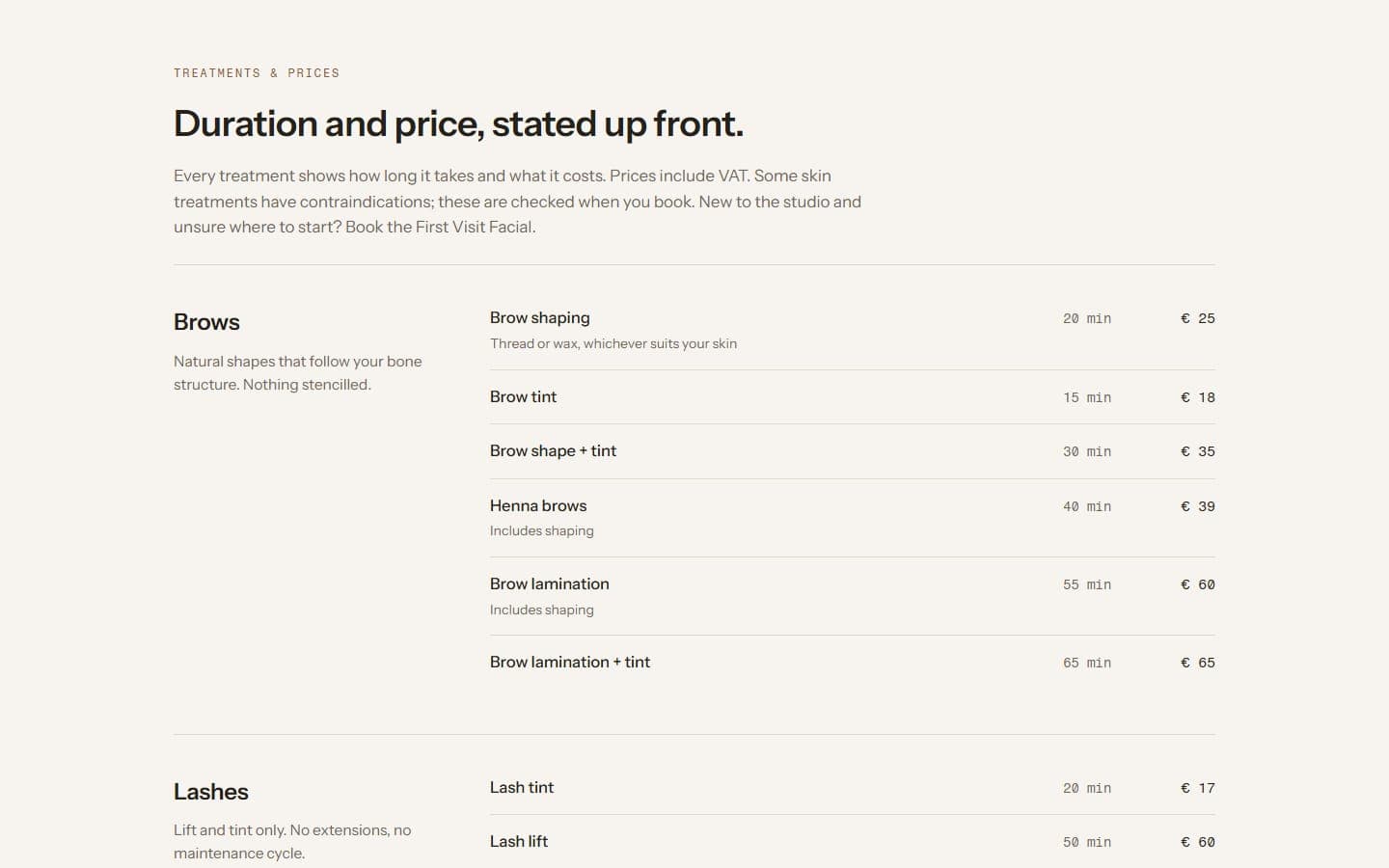
Elin Skin & Brow, a beauty studio in Amsterdam, shows every treatment on the site we built with its minutes and its price, in a table a client scans in seconds. Studios there publish both as a matter of course, so a site that hid either would read as evasive. The case study records twice as many appointments booked without a message first.
Owners who hide their prices usually fear two things: a competitor undercutting them, and a low figure drawing in bargain hunters. A competitor can find your price with one phone call, so hiding it protects very little. The bargain hunter is the person a price should filter out, before they take an hour of your week.
Work you cannot price without a visit still deserves a number of some kind. Redfern Plumbing & Heating, a two-van heating firm in Manchester, states price bands for a boiler replacement beside its quote form, before the form asks a single question. Their old form asked eleven questions and never mentioned money. A band tells the homeowner whether the job fits their budget, and the repairs that need someone to look stay as a quote.
The wording counts as much as the figure. Write from only when the number is the true lowest, and say what moves it up, such as a longer treatment or an older boiler. Say whether it includes VAT. A price that grows on the phone or at the checkout costs you more trust than a higher one stated plainly at the start.
Some prices belong off the page. A roofer cannot give a figure for a full re-roof before seeing the roof, so the page should say how that work is priced and what the survey visit involves, and nobody arrives expecting a number. A business whose prices change every week with what it buys in does worse with a list it cannot keep current than with a phone number and a line saying prices change.
The worst price on a website is an old one. A café that keeps its menu in a PDF with last season's prices sends the customer two doors down. A Business website, from £1,300, comes with an editor for the parts that change, prices among them, and changing a figure takes a minute. On smaller builds, the Care Plus plan at £85 a month covers small content changes.
Starting prices, UK, before VAT
Business website
from£1,300
5–10 pages, with an editor so you can change the words and photos yourself. Our most common build.
Care plan, Plus
£85/mo
Basic, plus small content changes each month and a priority reply.
We put our own prices on our site for the same reason we tell clients to. An owner who sees that a Starter website begins at £800 knows within a minute whether to talk to us, and the people who do call already know the number. Send us your price list, or the jobs you think cannot be priced, and we will tell you which belong on the page and how to word them.
Written by Maksym Gavrylenko · Published